Fire and fever: a new spatial awareness

My first post on this site treated the toxic Melbourne air as a result of the large bushfires burning around the country. In that post I considered how the toxicity of the air changed the way air looked and smelled, making us suddenly aware of its presence. The threat of bad air heightened our awareness of our senses, allowing us to pick up on any irregularities in the air. I would argue that it changed the way that we interacted with the space around us, including the normally unnoticed gaseous aspects of that space. Although today, the continued fires around Australia are all but vanished from our minds, a similar awareness of the space around us is evident during the current coronavirus pandemic. The disease has sensitised us to the air and spaces around us and their potential harmfulness. The virus, just like the toxic air, makes us attentive to space in new and unexpectant ways.

To demonstrate, think of your most recent visit to the supermarket. Weren’t you suddenly acutely aware of every part of your body (and even clothes) that were in direct contact with the spaces and objects around you? It was almost as if you were left with a burning invisible mark on your hand after having picked up the shopping basket. As you walked around the shop were you not intensely conscious of the way other people were moving in relation to you? Someone was standing too close to the brand of soymilk you wanted to grab so you hesitate for an extra movement, waiting for them to move on. As you turned around a corner, looking for the non-existent liquid hand soap did you not almost bump into someone moving towards you and suddenly, without thinking, you found yourself holding your breath? Some of us have taken to protective measures such as disposable gloves and face masks, attempting to create a protective barrier between ourselves and the outside world. Others, we are almost too fearful to go outside at all. As you escaped the supermarket you took your first deep breath in a while and made your way home, still feeling the germs burning the skin of your hands. The current health crisis has heightened our sense of touch to a point where we can feel the burning of unclean skin, it has sensitised us to our place in relation to the space and the people around us and it has made us intensely aware of the sounds and signs of flu symptoms.

These are new experiences for most of us and they can be understood as a different awareness of space. The invisible virus threatening us cannot be seen by the naked eye, yet it is perceived by every part of our body. The fact that we do not know if it is there makes us constantly assume that it is. Sure, we might slip up for a moment, moving our unclean hands to our faces, but we soon remember, kicking ourselves for our mistake. Of course, we were always aware that venturing into public space and the proximity of other people meant exposing ourselves to the risk of different forms of infections. However, never before have we been so keenly aware of the risk. Similar to the way the toxic air during the bushfire season made us aware of its existence, we are becoming cognisant of the fact that the virus might be present in the air that we move through or the places that we touch. Once this virus no longer is considered everywhere around us, most of us will return to moving through space in a manner similar to before. Nonetheless, just as with the air during the bushfires I think that, in a way, the virus pandemic will come to slightly change our relationship to space for quite some time.

For more considerations on the sounds of the pandemic and what it does to us, have a listen to the podcast ‘Listening to the city in a global pandemic’.
After pandemic

The coronavirus pandemic has transformed human behaviours around the world with some positive effects on the environment. In Australia, everyone whose work allows it is now working from home which means that less people are commuting to and from work each day. There is very little international travel and much less national travel taking place as state borders are closing and we are encouraged not to undertaking any unnecessary travelling. In addition, some industries have temporarily reduced their activities. I am, for example, now working from my home and I only leave my house to buy groceries, go for a run, a walk or to sit down at the creek close to my house. I have had to cancel my planned international trips to conferences and to see my family back in Sweden. These changes in mine and in millions of people’s lives have led to a slashing of air pollution globally as observed by the European Space Agency via satellite images. Although from a personal perspective the pandemic and the isolation are both tragedies, from a purely environmental perspective, these are all important behavioural changes and vital pollution reduction that we have been waiting for.

This is a time when we all worry about the future, wondering whether after the pandemic, life will return to something resembling normality. The Chinese city Wuhan, where the virus was first detected in December last year is now slowly lessening their strict mass quarantine rules. This, I think, is providing us all with some sanguinity. I hope that soon we can go back to living without the anxiety of death and disease being all around us. I also hope that we once again will seek closeness and social inclusion rather than fearing the person beside us and practicing social distancing. But will we also go back to travelling as much as we did before? I certainly hope not.

As someone who has been working from home for two weeks now, I do not believe it to be a good solution for everyone, or at least not every day. Nonetheless, perhaps those who can should work from home two days a week or find alternatives to the car. Moreover, there are a lot of national and international meetings that quite successfully can be undertaken via conference calls which has the potential to lessen the degree of business trips. If you drive to the grocery store, perhaps try to make less trips in a week and consider what consumption practices are absolutely necessary. In rough times it is natural to wish for something positive to arise as a result, for all the suffering to have led to something good. I would hope that this experience in all its tragedy could open up our minds towards alternative ways of life. I also hope that it has shown us how able we are to act and adapt in order to save lives. In what is hopefully not more than a few months, as we once again rebuild our societies after this frightening disruption, let us think about what world we want to live in and what we want Earth to look like in 20, 50 and 200 years. And then let us consider the best possible way forward and work together to get there.

Emergency framings and the power to act

What does the Coronavirus disease (COVID-19) mean to you? (Feel free to comment on the post) It seems to me that the threat of the virus does different things to different people. Whereas some people take pride in continuing business as usual, treating the virus as a media panic, others are deeply concerned. There are clear signs of anxiety and fear in the population. The threats of isolation and a trade standstill are just as pertinent as the disease for many. This is seen not the least in the competition to get our hands on toilet paper and the food with the longest shelf life. COVID-19 has turned many of us into ‘survivalists’, a term referring to people convinced of and preparing for the end of the world as we know it due to changing climates.Following failures to contain the virus within China, governments around the world are responding forcefully by restricting travel, access and social gatherings.This is the aspect of the pandemic that stands out to me the most. The extent and the speed of the response to the virus, unlike anything many of us have ever experienced before.Although, climate change is increasingly considered an emergency, the forceful response to the virus is unparalleled to anything yet witnessed in relation to climate change.

COVID-19 is showing us the full capacity of the governments’ powers. In a moment of crisis, they can put in force regulation making everyday lifeunrecognisable. The Federal government of Australia was quick to put in place a travel bans from China, restricting access for a lot of people attempting to return to work and studies in Australia. More recently a travel ban from Italy was put in place and a number of countries have closed their borders completely. The reactions to the virus are thus reinforcing national boarders as these are seen as natural boundaries to be protected, while the virus continues to transgress these restrictions. In addition, on Friday the Federal government announced that any gatherings of over 500 people are to be cancelled. This is assumed to be just the beginning of increased restrictions. Victoria and the Capital Territory have now joined various other states and announced a state of emergency due to the virus. This endows the authorities with additional power to impose a 14-day isolation period for all people arriving in Australia, with large ramifications on the tourist industry. It also gives authorised officers the power to detain people and to prevent or restrict peoples’ movements. In Italy, for example, the government has restricted the movement of people in the whole country. They are only to travel to work and for health purposes. Gyms, theatres, sport events, schools and universities are all closed while restaurants and cafes are allowed to operate until 6 pm. In Australia it seems we are moving in this direction.

Perhaps this is an indication of what is to come as the effects of climate change become increasingly tangible. However, the main argument I want to put forth here is that the measures put in place to prevent the propagation of the virus speak to the governments’ capacity to act in times of crisis. Faced with an emergency, democratic governments can endow themselves with the additional power to act, as proven by the restrictions imposed to contain the current pandemic. What COVID-19 is showing us is the width of restrictions put in place to protect public health. This seems to be quite reasonable restrictions, considering the harm associated with a rapid peak of infections. However, it highlights the lack of response in relation to the slower process of climate change. Why is the government not reacting more forcefully in response to climate change? Comparatively, travel bans could be put in place, transport could be restricted and mass gatherings requiring large amounts of energy could be stopped to reduce strain on the climate. But none of this is being done.

Extinction rebellion and others are protesting governments’ inaction to address climate change. They argue for the framing of climate change as an emergency and for political leaders to treat it as such and launch into action. Climate change is like a much slower virus that has been spreading around the globe for over a century. Most of us are carriers, manly the wealthier nations in the Global North. Nonetheless, just as in the case of COVID-19, the most vulnerable populations will be the worst affected. Yet, little is being done to mitigate the effects and to halt its development. Climate change is, contrary to scientific evidence, not considered an emergency on par with the corona pandemic. It appears that the slower heating of the globe does not warrant immediate political action whereas the more rapid spread of the virus is. The government has the power to make important changes, but the slower development of climate change is not provoking the same response. Climate change might be happening at a slower rate but let us not be misled, we might already be past the point of no return.

Enter: Fire

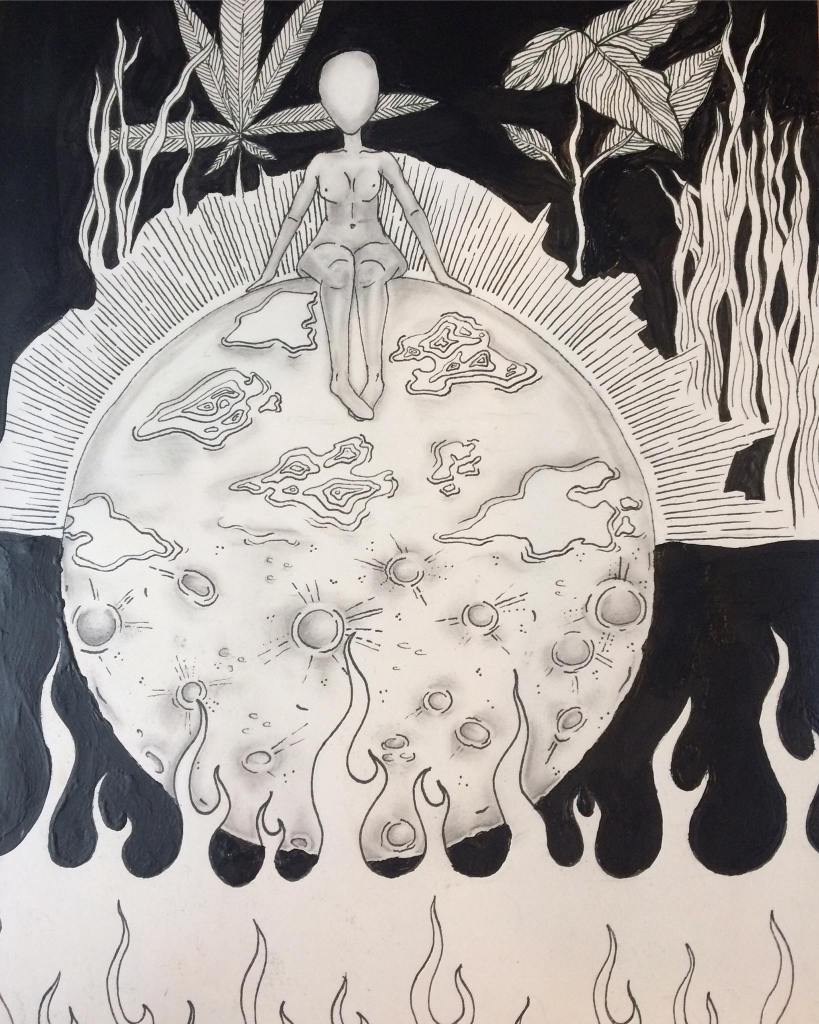
Drawing by Lina Hälleberg

The Anthropocene is a name given to the geological epoch during which human beings have come to fundamentally change the geology and ecosystem of the Earth. Increasingly we are controlling the world around us, removing unwanted vegetation and habitats, turning pastures into cities, paths into paved roads. We have drilled the Earth’s core, built towns in the desert, domesticated animals and introduced non-native species. The list goes on and on. I find it important to take a step back and remind ourselves that this is a self-proclaimed right. Other animal species utilise the gifts from Earth to keep themselves and their gene pool alive. In contrast, we, the rich and wealthy, take from the Earth in order to achieve increased luxury, status, enjoyment and wealth while others suffer devastating famine, injury and death. We want to move faster and reach higher than anyone else, we want to conquer the land, the water, the atmosphere and the outer space. We are indeed ruling Earth with an iron fist. The realisation that the effects of unrestrained human activity is reverberating over the planet and attempts to ameliorate the damage is making this abundantly clear; such as our efforts of keeping species at the edge of extinction alive and to prevent others from proliferating. We might seem to be in complete control of the planet. But then there is fire reminding us of our limitations.

Last year we witnessed another devastating bushfire season in California, largescale fires in the Amazonas – that along with deforestation is considered especially destructive for the ecosystem – and hundreds of bushfires in Siberia and Indonesia affecting the air quality in nearby cities. In Australia the fire season started early and is considered to be one of the worst ever recorded. These fires followed extreme heat and below average rainfall. The harm and damage from these fires are due to their location, many burning along the eastern part of the country, close to many human settlements. Many people have lost their lives, many more their homes, millions of acers of land have burnt, animals are dead or dying and the fire season is far from over.

Fire moves in and removes everything in its path. It is the Earth rising up against its emperor – not overthrowing it but weakening it substantially. As long as people have lived on this planet, fire has been by their side. Fire on Earth is indeed like the mythological Phoenix, causing death only for life to rise again from its ashes. After vegetation burns, new life returns. With fire by our side we have been able to conquer the world, remoulding the land encountered, making it habitable for us. But at times fire also keeps us in place. It comes in, it destroys, and it shows us that what we have built, the security induced oasis in its path, is in fact instable and fleeting. Reports of increased and more severe fires around the world following Anthropocene climate change, makes me wonder if fire is entering as the new dictator on Earth. Can we regain control over it, will we be forced to follow its orders, or can we learn to live side by side, respecting each other’s territories?

But how come the Australian government is denying the fact that fire has entered the political arena? While acknowledging the victims of fire, many Members of Parliament are still denying the fact that fires are exceptional and that they are induced by climate change. Now, I suppose it is a political game, part of its grandstanding, not to look the challenger in the eye and not to acknowledge their sway. Pretending that your adversary is lesser than you and indeed wishing for it to be so. But Scott Morrison, the next election is impending, fire is gathering its forces and the people, the people that you represent, are calling for a meeting between fire and you. We want to witness your confrontation, listen as you acknowledge fire’s existence and follow along as you prepare for the most important showdown of your life.

Attuning to air and atmosphere

Over the Christmas holidays, I left Melbourne to spend a few weeks in Sweden with my family. A few days before my return to Melbourne I was reached by the news that Melbourne was experiencing reduced air-quality due to drifting smoke from the large bushfires along the Victorian coast. As I landed in Melbourne a few days later, the air quality was very bad. It was the morning on the 15th of January, the air was glimmering yellow in the morning light and it tasted off. Although air is necessary for survival, breathing is an unconscious reflex which is often forgotten about. However, Choy reminds us that in places where air quality is bad, it becomes a topic of medical, political and social importance. Decreased air quality forces us to think about the atmosphere in more concrete ways. I know that for me, to check the air quality in my neighbourhood has now become a regular part of my morning routine. I have also downloaded an app which gives me daily updates, similar to weather notifications. Apart from employing such technological means of control, I am increasingly aware of the sight, taste and smell of the air. Preferably, air should not be seen or tasted but during bad days it is like you can see the dust and the chemical particles moving in the air, smell dirt in the wind and sense the minute particles through your taste buds. Twice so far, I have run around my house at night whiffing, after having detected an unusual smell, only to draw the conclusion that it must be coming from the air outside.

So, at least for me, the fact that air quality has become an issue in the city where I live is making me aware of air in ways that I previously was not. In addition, the fact that the air quality is not constant but rather erratic and changing intensifies this experience. A few years back I spent some months in Mexico City. At the time I would sometimes hear reports of the damage of breathing the air there being equivalent to smoking a packet of cigarettes a day or something to that effect. That is not a pleasant thing to hear but something that I quietly accepted and mostly avoided thinking about. The bad air was constant and largely due to the compact and laxly regulated traffic in the city. Nonetheless, the consistency of the air allowed me, for the most part, to forget about it. Similarly, recently I was complaining to my partner about the bad air in Melbourne and he, who had just returned from a trip to his hometown Dhaka, Bangladesh, answered by telling me about the air quality in Dhaka which often reaches hazardous levels. This of course does not stop people from going about their daily activities and I highly doubt they check the air-quality index each morning. Since, I believe, once again, the air quality is always pretty bad. In contrast, recent bad air in Melbourne has been a temporary and varying condition. ‘Hazardous’ air in the morning might be ‘moderate’ in the afternoon and ‘good’ the next day. Although the air quality has been good for a while, before going for a run I check the air to make sure that it hasn’t decreased.

Whether this acute attention to air would last even if the air quality continued to fluctuate, I do not know. Perhaps even that we would get used to. But for now, many people around Melbourne are on hyperalert for bad air and hazardous conditions as bushfires around the state are expected to burn all summer. This puts us in touch with air and the atmosphere within which air circulates in new, terrifying and exciting ways. Whether this attunement to air will lead to a change in behaviour or stricter carbon emission targets, is yet too early to say. What is clear is that we now exist in an atmosphere of increased climate urgency, which is making many people realise that climate change is affecting us here and now, not only there and then.

Atmospheres of change

It is the changing winds, smells and tastes on Earth. It is about the liquid, the solid, the gaseous, the living, the dying and the in-between. It is about the human, the more-than-human and the relationship between the two. There are atmospheres of change, both in the physical and metaphorical sense. I love joining words together in such sequences, more of which will follow in this semi-academic blog.